
Value engineering is often misunderstood before a construction project even begins. Some property owners hear the term and assume it means finding cheaper materials, eliminating features, or reducing the quality of the finished project.
That is not what good value engineering consulting is supposed to do.
At Spiegel Wellman Contractors, we look at value engineering as a practical review of cost, design intent, constructability, materials, scope, and long-term priorities. The objective is to identify where money is being spent effectively, where unnecessary costs may exist, and whether another approach can achieve the intended result without creating a new problem somewhere else.
That distinction matters on Brentwood construction projects, where custom designs, major renovations, structural work, finish selections, site conditions, and permitting requirements can make seemingly small decisions affect several parts of the budget.
Key Takeaways
- Value engineering consulting is not the same as choosing the cheapest materials or contractor.
- A lower upfront price can create greater costs later if it reduces durability, complicates installation, or changes the intended result.
- The best time to value-engineer a project is usually before construction, while plans and selections can still be adjusted efficiently.
- Good value engineering considers scope, labor, materials, engineering, scheduling, and constructability together.
- Some expensive elements should remain untouched when they are essential to safety, performance, durability, or the homeowner’s priorities.
- The goal is better allocation of the construction budget, not cost reduction at any price.
What Is Value Engineering Consulting?
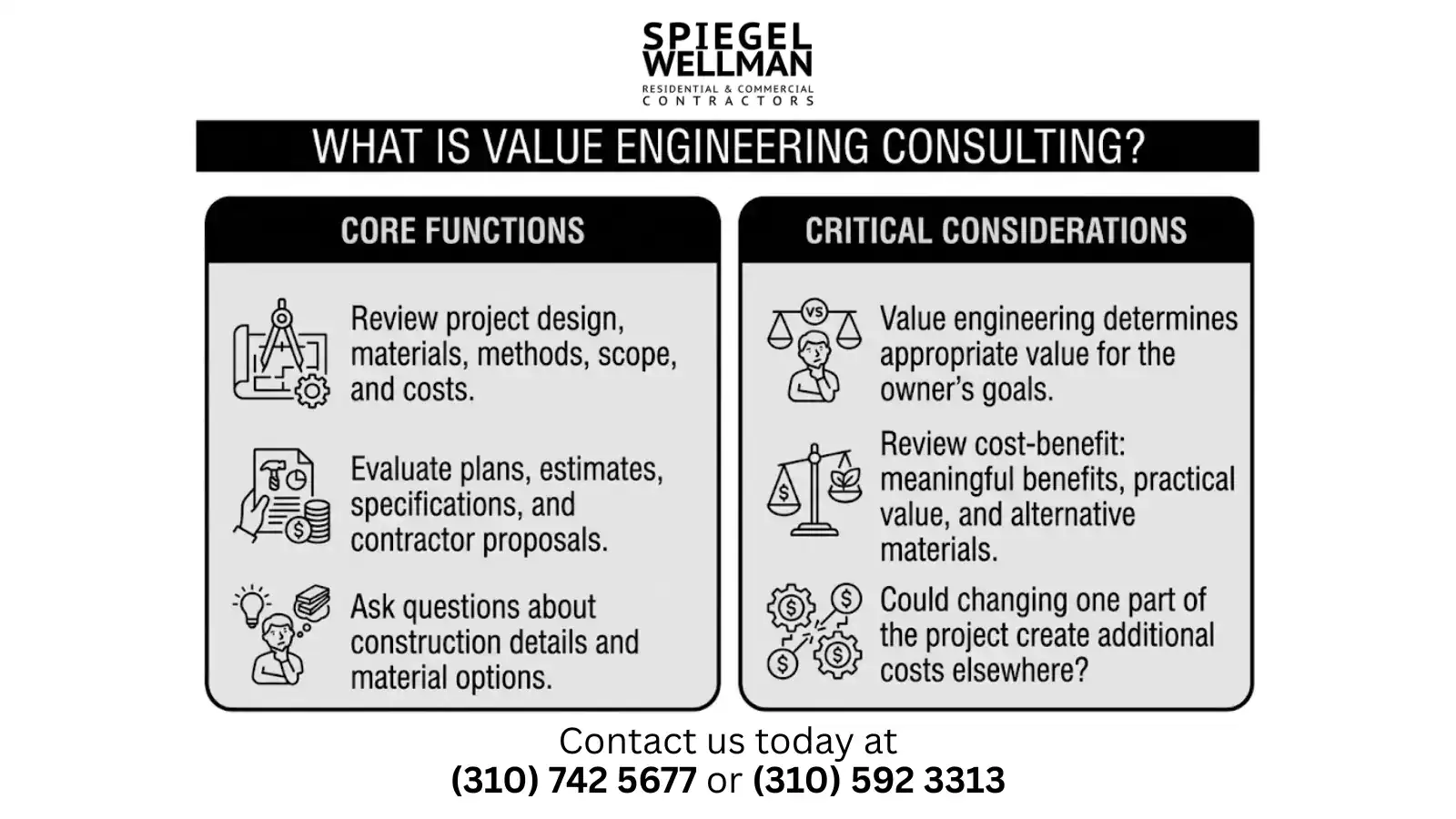
Value engineering consulting is the process of reviewing a construction project to determine whether its design, materials, methods, scope, and costs are producing appropriate value for the owner’s goals.
That may involve studying plans, estimates, specifications, contractor proposals, material selections, structural requirements, or construction methods.
A consultant might ask questions such as:
- Is there a more efficient way to build this detail?
- Is an expensive product providing a meaningful benefit?
- Can the same design intent be achieved with another material?
- Is the project paying a premium where the homeowner receives little practical value?
- Will a proposed change actually save money after labor and installation are considered?
- Could changing one part of the project create additional costs elsewhere?
At Spiegel Wellman Contractors, our estimating work includes reviewing project scope, plans, specifications, site conditions, trade costs, and potential value-engineering opportunities. Our construction consulting services can also include proposal, scope, budget, schedule, and preconstruction review.
The important point is that value cannot be judged by price alone.
Call (310) 742-5677 to discuss your project
Misconception #1: Value Engineering Means Making Everything Cheaper
This is probably the most common misconception.
Value engineering is not a search for the lowest possible price. It is a search for a better relationship between cost and the result you actually need.
Sometimes the less expensive option is the better decision. Sometimes it is not.
Consider a material that costs less to purchase but requires substantially more labor to install. The material savings may disappear once installation is included.
Or a cheaper product may require more maintenance or replacement sooner than an alternative. That can shift expenses into the future rather than eliminate them.
Effective value engineering looks at the larger decision.
Cost and Value Are Different
A lower price answers one question:
What does this cost now?
Value asks several:
What are we getting for that cost? How difficult is it to build? How will it perform? Does it support the design? What other work does the decision affect?
Those questions lead to better construction decisions than simply selecting the lowest number.
Misconception #2: Value Engineering Automatically Reduces Quality
A properly considered value-engineering change should protect the project’s important priorities rather than compromise them without reason.
There are often several ways to solve the same construction problem.
Two products may have very different prices because of branding, sourcing, fabrication, installation requirements, or features that the project does not actually need. Two construction details may achieve a similar result while requiring different amounts of labor.
That creates room to evaluate alternatives.
Our approach is to identify practical materials and methods that may reduce unnecessary premiums while preserving overall quality and design intent.
There Are Areas Where Cutting Cost May Be the Wrong Decision
Value engineering does not mean every expensive item needs an alternative.
A proposed change deserves more scrutiny when it affects:
- structural performance;
- waterproofing or weather protection;
- required code compliance;
- critical building systems;
- long-term durability;
- a major architectural feature that is central to the design.
If reducing a cost introduces greater risk or undermines an important project goal, the supposed “savings” may not represent good value at all.
Misconception #3: Value Engineering Happens After the Estimate Is Too High
Value engineering can certainly help when an estimate exceeds the intended budget. But waiting until that point can limit the available options.
Value engineering is generally more useful when it begins during design and preconstruction.
Early review gives the project team more freedom to compare different materials, details, layouts, systems, and construction methods before those decisions become difficult to change.
At Spiegel Wellman Contractors, our process coordinates plans, design requirements, engineering needs, construction estimating, and buildability review during project planning. This creates an opportunity to identify value-engineering options before construction begins.
Why Timing Matters
Changing a detail while it exists only on a plan may require a conversation and a drawing revision.
Changing it after materials have been purchased or work has been installed could involve:
- demolition;
- replacement materials;
- additional labor;
- schedule disruption;
- revised trade coordination;
- new approvals or documentation.
The later a decision changes, the more parts of the project it may affect.
That is why preconstruction value engineering can be more useful than treating it as an emergency response to an over-budget project.
Misconception #4: Any Material Substitution Is Value Engineering
Replacing one material with a cheaper one does not automatically qualify as sound value engineering.
The alternative needs to be evaluated in context.
Suppose a replacement material costs less per square foot. That looks attractive until its installation requires more preparation, specialized labor, additional structural support, or a longer lead time.
Suddenly the calculation changes.
A useful material comparison should consider more than purchase price.
Questions We Consider Before Recommending an Alternative
We look at issues such as how the product will be installed, whether it works with adjacent materials, whether the design changes, and whether the expected savings remain meaningful once construction requirements are considered.
Availability matters too. A material that appears cost-effective but has an unpredictable lead time could create scheduling problems.
The right choice depends on the project, not simply the price tag.
Misconception #5: Value Engineering Is Only About Materials
Materials receive a lot of attention because they are easy to compare. But construction costs involve much more than finishes and products.
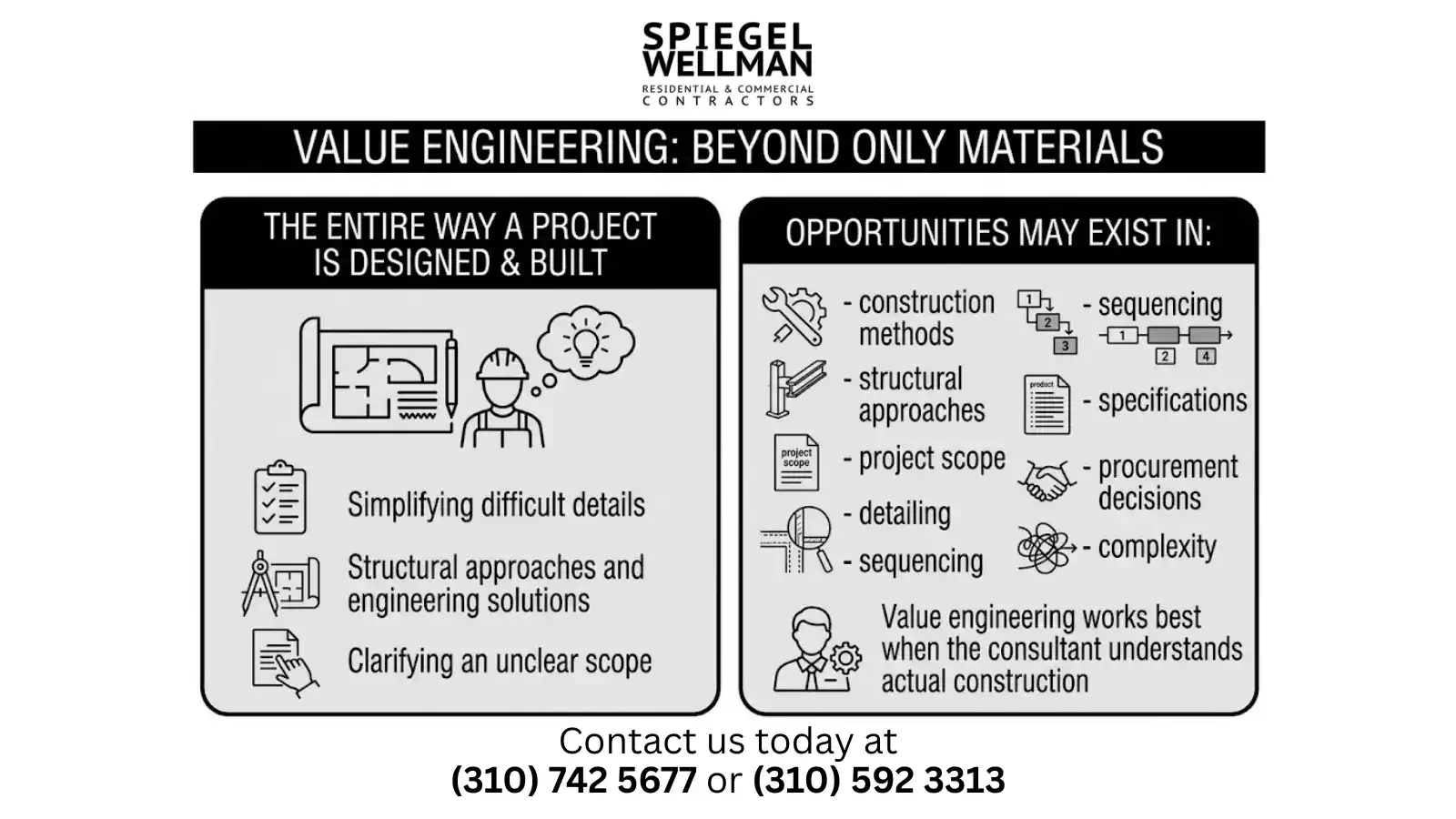
Value engineering consulting can examine the entire way a project is designed and built.
Opportunities may exist in:
- construction methods;
- structural approaches;
- project scope;
- detailing;
- labor-intensive features;
- sequencing;
- engineering solutions;
- specifications;
- procurement decisions;
- unnecessary complexity.
Sometimes simplifying a difficult detail creates greater savings than substituting a finish.
Other times, clarifying an unclear scope prevents duplicate pricing or future change orders.
This is why value engineering works best when the consultant understands actual construction rather than reviewing costs only from a spreadsheet.
Call (310) 742-5677 to discuss your project
Misconception #6: The Lowest Contractor Bid Already Includes the Best Value
A low bid and good value are not the same thing.
Contractor proposals can differ because contractors interpreted the plans differently, carried different allowances, excluded different work, selected different materials, or made different assumptions about the project.
A lower proposal might represent a real savings.
It might also represent missing scope.
Our construction consulting services include reviewing contractor proposals, pricing structures, allowances, exclusions, qualifications, and differences in scope. That type of comparison helps identify what each number actually represents before an owner makes a decision.
Compare Scope Before Comparing Totals
Imagine one proposal includes a required item and another does not.
Looking only at the bottom-line price makes the second proposal appear less expensive. Once the missing work has to be added later, the difference may shrink or disappear.
A useful bid comparison therefore asks:
Are we comparing the same work?
Until that question is answered, price alone can be misleading.
Misconception #7: Value Engineering Only Benefits Large Projects
Large custom homes and major renovations may present more opportunities because they contain more materials, trades, systems, and design decisions.
But the basic principle applies to smaller projects too.
Whenever a project contains meaningful choices about scope, materials, construction methods, contractor proposals, or design details, there may be opportunities to improve value.
What changes is the depth of the analysis.
A targeted renovation may need only a focused review of several expensive decisions. A major Brentwood remodel or custom home can require ongoing cost planning as the design develops.
The effort should match the complexity of the project.
Misconception #8: Value Engineering Is the Same as Estimating
Estimating and value engineering are closely related, but they serve different purposes.
Estimating tells you what the proposed work is expected to cost. Value engineering examines whether there may be a more efficient way to achieve the project’s objectives.
A detailed estimate creates the information needed to see where money is being spent.
Value engineering uses that information to ask better questions.
For example, an estimate may show that a particular architectural detail carries a high labor and material cost. Value engineering then considers whether that cost is justified or whether another detail can accomplish a similar objective more efficiently.
At Spiegel Wellman Contractors, our estimating services can include preliminary budgeting, detailed construction estimates, trade and material pricing, scope review, and value-engineering analysis.
Misconception #9: Every Expensive Feature Should Be Value-Engineered Out
A project’s most expensive items are not necessarily its least valuable ones.
A homeowner may place high importance on a particular architectural feature, room configuration, finish, window system, or material.
If that element is central to the project, eliminating it simply because it costs more could defeat the reason for undertaking the work.
A more useful approach is to establish priorities.
Protect High-Priority Features and Review Lower-Priority Costs
Suppose a homeowner considers a particular kitchen layout essential but cares less about an expensive material specified elsewhere.
The right value-engineering decision may be to protect the kitchen and find savings in another part of the project.
That is budget allocation.
Good consulting helps identify where each dollar matters most rather than applying the same cost-cutting standard everywhere.
Misconception #10: Value Engineering Guarantees a Specific Amount of Savings
No responsible consultant should assume that every project contains a predictable percentage of removable cost.
Some projects provide significant opportunities. Others have already been designed efficiently.
The potential also depends on when the review takes place.
A project still in design usually offers more flexibility than one with permits issued, products ordered, and construction underway.
Other variables include the project scope, specifications, property conditions, structural requirements, finishes, contractor pricing, and the owner’s priorities.
For that reason, the better goal is not a predetermined savings percentage.
The goal is to determine whether the project budget is being used intelligently.
What Does a Value Engineering Consultant Actually Review?
The exact review depends on the project stage and the information available.
A consultant may examine plans, specifications, estimates, proposals, allowances, selections, schedules, or proposed construction methods.
For a project still in design, the focus may be on major cost drivers and constructability.
For a project preparing for contractor selection, comparing scope and proposals may become more important.
Once construction has started, the available choices may narrow, but targeted decisions can still benefit from an experienced review.
At Spiegel Wellman Contractors, our consulting support can range from a one-time project consultation to preconstruction review and ongoing owner support.
Why Constructability Matters in Value Engineering
A design can look straightforward on paper and still be expensive to execute.
Constructability refers to how practical a design is to build under real project conditions.
An unusual detail may require extra framing, custom fabrication, difficult installation, additional coordination, or a specialized trade. None of those factors automatically make the detail wrong, but they affect its cost.
A construction-informed value engineering review connects design decisions with what will happen in the field.
That relationship is particularly important when design, engineering, and construction overlap. Spiegel Wellman coordinates engineering with drafting, permitting, budgeting, and construction so technical decisions can be considered alongside practical execution.
Value Engineering in Brentwood Construction
Brentwood projects can range from focused property improvements to major remodels, additions, and custom residential construction. Spiegel Wellman serves Brentwood with coordinated design, engineering, estimating, permitting, preconstruction, and building services.
For these projects, value engineering may become especially useful when the design involves substantial structural changes, customized details, premium finishes, additions, or multiple building systems.
The more interconnected the project becomes, the more important it is to understand the consequences of changing one element.
A material substitution could affect the design.
A structural change could influence plans and engineering.
A layout revision could affect plumbing, electrical work, cabinetry, finishes, or other trades.
The strongest value-engineering decisions therefore consider the project as a whole.
When Should You Consider Value Engineering Consulting?
Consider value engineering when you still have enough flexibility to act on the recommendations.
That may be:
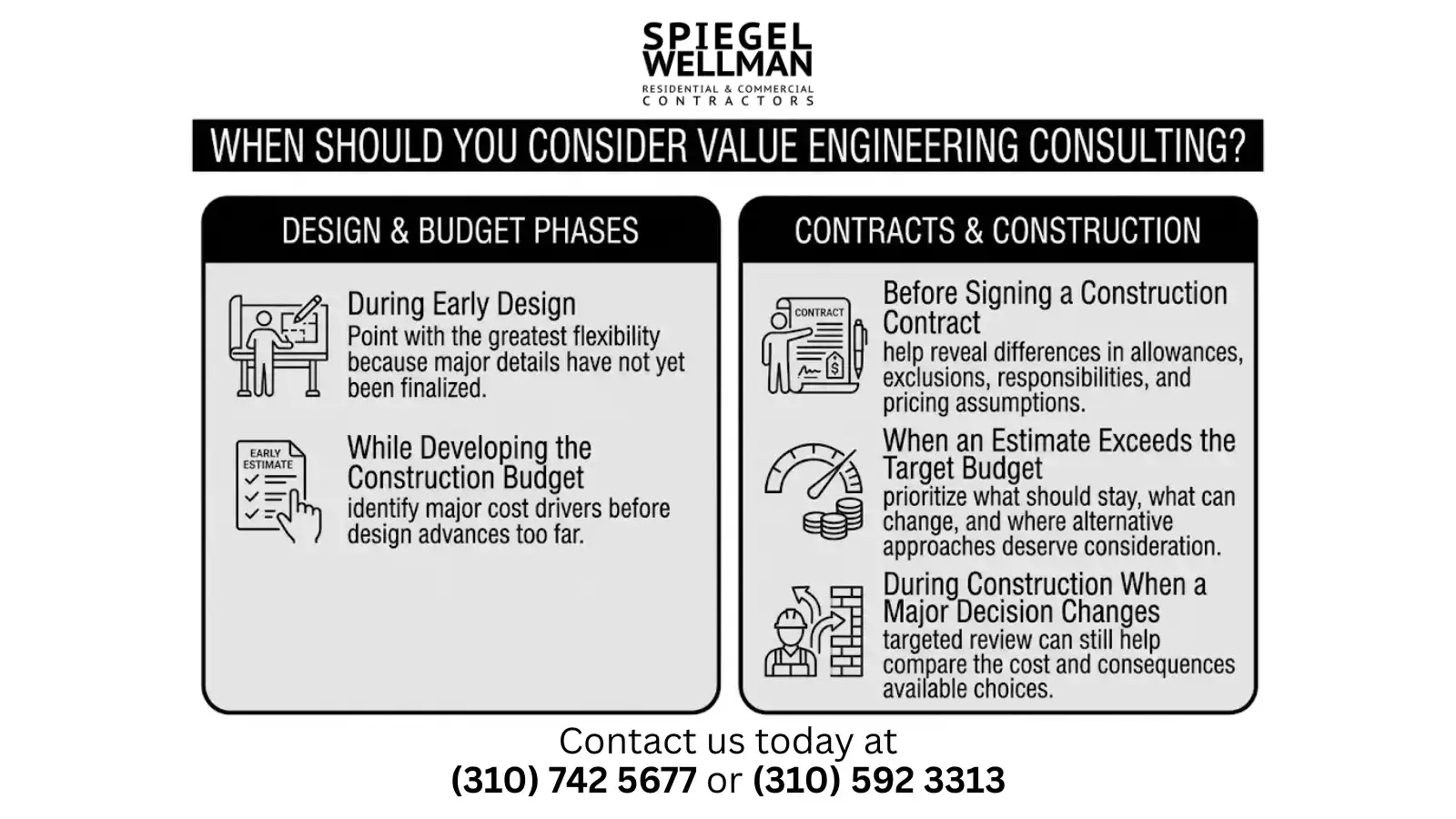
During Early Design
This is often the point with the greatest flexibility because major details have not yet been finalized.
While Developing the Construction Budget
Early estimates can identify major cost drivers before the design advances too far.
Before Signing a Construction Contract
A proposal and scope review can help reveal differences in allowances, exclusions, responsibilities, and pricing assumptions.
When an Estimate Exceeds the Target Budget
Value engineering can help prioritize what should stay, what can change, and where alternative approaches deserve consideration.
During Construction When a Major Decision Changes
Although fewer options may remain, targeted review can still help compare the cost and consequences of available choices.
Call (310) 742-5677 to discuss your project
How to Tell Whether Value Engineering Is Actually Creating Value
A good recommendation should make sense beyond the immediate price reduction.
Ask four basic questions:
- What are we giving up?
Understand whether the change affects appearance, durability, performance, maintenance, or another priority. - What is the real savings?
Consider labor, installation, related work, and other project effects rather than material price alone. - Does the change create another problem?
Savings in one trade can create additional work for another. - Does this support the owner’s priorities?
The cheapest solution is irrelevant if it removes one of the features the homeowner values most.
That is the core of value engineering: looking at the whole decision.
Make the Budget Work Harder, Not Simply Smaller
Value engineering should not begin with the assumption that quality must be sacrificed to reduce cost.
The better question is where the construction budget creates meaningful value and where money may be spent without a corresponding benefit.
At Spiegel Wellman Contractors, we combine construction consulting with estimating, design, engineering coordination, plans, permit expediting, and construction experience. Our goal is to help owners understand their options before costly decisions become difficult to reverse.
If you are planning a construction or remodeling project in Brentwood and want an experienced review of your budget, plans, proposal, or project approach, Contact us at (310) 742-5677 to discuss your next steps.
Frequently Asked Questions
Q: What is value engineering consulting?
A: Value engineering consulting reviews a project’s design, scope, materials, methods, and costs to identify ways to improve overall value. The goal is not simply to make the project cheaper. A strong review considers whether proposed alternatives maintain the performance, design intent, durability, and priorities that matter to the owner.
Q: Is value engineering the same as cost cutting?
A: No. Cost cutting focuses primarily on reducing expense, while value engineering compares cost with function, quality, constructability, and project priorities. A cheaper option is only useful when the trade-offs make sense for the project.
Q: When should value engineering begin?
A: Value engineering is often most useful during design and preconstruction because the project still has flexibility. Changes become harder and potentially more disruptive after materials have been ordered or work has already been installed.
Q: Can value engineering reduce construction quality?
A: Poorly considered cost reductions can reduce quality, but that is not the objective of proper value engineering. Alternatives should be evaluated for performance, durability, installation requirements, appearance, and other relevant factors before a change is recommended.
Q: Can value engineering help if my construction estimate is over budget?
A: Yes. An over-budget estimate can be reviewed to identify major cost drivers and compare possible alternatives. However, the available options depend on the design, project stage, structural requirements, material selections, and the owner’s priorities.
Q: Does Spiegel Wellman Contractors provide value engineering consulting in Brentwood?
A: Yes. We provide construction consulting, estimating, scope and plan review, proposal evaluation, and value-engineering support for projects in Brentwood and other Los Angeles communities. The appropriate level of review depends on the project and its current stage.
Services We Also Serve