
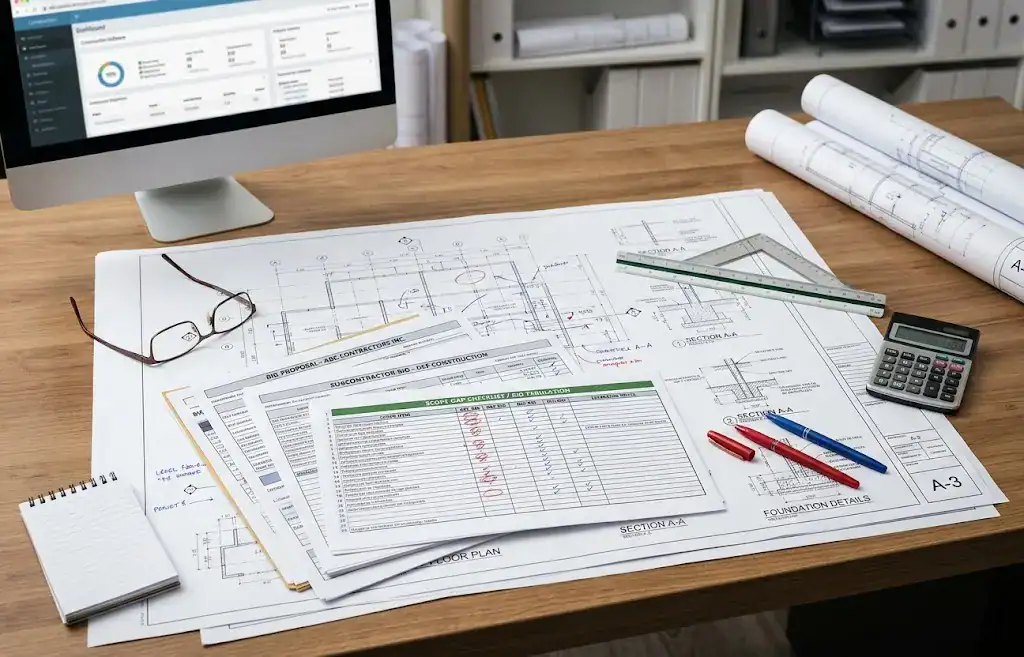
Two contractor bids can describe the same home project and still cover different work. One may include demolition, debris removal, and finish repairs. Another may price the main installation while leaving those supporting tasks outside the total.
A construction cost estimator checks for missing scope by comparing each proposal with the plans, specifications, selections, and site information. The review looks beyond the final price to identify unclear responsibilities, excluded work, and allowances that need further definition.
At Spiegel Wellman Contractors, our estimating services include scope and plan review, trade pricing, and preconstruction cost planning. For homeowners in Pacific Palisades, understanding what a bid covers is an important step toward a workable construction budget.
Key Takeaways
- Compare bids against the same plans, selections, and written scope.
- An item without a separate price is not automatically excluded; ask for confirmation.
- Allowances, exclusions, and undefined responsibilities deserve close attention.
- Check the work between trades, including preparation, connections, and repairs.
- Resolve known gaps in writing before using the bid as the basis for a contract.
What Does Missing Scope Mean in a Contractor Bid?
Missing scope is work needed for the intended project that has not been clearly accounted for in the proposal or assigned elsewhere.
Consider a window replacement. A bid might include the windows and installation but say little about removing the existing units, repairing surrounding surfaces, or painting disturbed areas. Those tasks still need an assigned responsibility.
However, a short proposal does not necessarily omit the work. A contractor may include several tasks within one larger price. The estimator’s job is to establish whether the work is covered, excluded, or still unclear.
We encourage homeowners to ask a direct question: “Where is this work included, and who is responsible for completing it?”
A clear answer is more useful than assuming either that everything is covered or that every unlisted item will cost extra.

Call (310) 742-5677 to discuss your project
How a Construction Cost Estimator Reviews Contractor Bids
A useful review follows the project from its documents through to completion. The estimator checks what must be built, how the work is divided, and which assumptions support the price.
1. Confirm That Everyone Priced the Same Information
Before comparing totals, confirm which documents each contractor used.
The review should identify:
- Drawing dates and revision numbers.
- Written specifications and finish schedules.
- Structural details and available site reports.
- Written answers issued during bidding.
- Owner selections and requested alternatives.
If one contractor priced an earlier layout while another used revised plans, their totals do not describe the same project.
Design completeness matters, too. An early budget based on a concept cannot offer the same detail as an estimate based on developed construction documents. The Whole Building Design Guide describes estimating as a process that becomes more defined as project scope and design information develop.
2. Break the Project Into Comparable Work Categories
Contractors organize proposals differently. One may provide a single bathroom price, while another separates plumbing, tile, fixtures, and electrical work.
An estimator brings those descriptions into a common comparison. This process is often called bid leveling.
The goal is to compare equivalent work without treating a blank line as proof of an omission.
| Work category | What needs clarification | Useful question |
| Demolition | Removal limits, protection, and disposal | Does this include hauling away the removed materials? |
| Site preparation | Access, excavation, and preparation assumptions | What site conditions does this price assume? |
| Structural work | Specified framing, connections, and supporting work | Does the price reflect the current structural details? |
| Plumbing and electrical | Rough installation, fixtures, and final connections | Are both rough work and final connections included? |
| Finishes | Surface preparation and repairs around new work | Who restores the areas disturbed by installation? |
| Completion | Testing, cleanup, and remaining corrections | What is included before the project is handed over? |
This comparison creates a list of questions that contractors can answer in writing.
3. Separate Allowances, Exclusions, and Unknown Conditions
These terms describe different budget issues.
An allowance is an amount included for a defined item that has not been fully selected or priced. A tile allowance, for example, needs to state whether it covers materials alone or also includes installation, delivery, and other related costs.
An exclusion identifies work outside the contractor’s price. That work may still belong in the homeowner’s total project budget.
An unknown condition is something that cannot yet be confirmed, such as the condition of framing concealed behind an existing wall.
A contingency is a budget reserve for uncertainty. It should not quietly substitute for pricing work that is already known to be required.
For each unresolved item, establish what is known, what remains uncertain, and what information would allow a firmer price.
4. Check Where One Trade’s Work Meets Another’s
Some gaps occur between otherwise complete trade proposals.
For example, an equipment installer may include setting a unit in place while excluding the electrical connection. The electrician’s proposal may not mention that connection either.
Similar questions arise around:
- Openings needed for pipes, ducts, or wiring.
- Supports and blocking for cabinets or equipment.
- Waterproofing around penetrations.
- Patching after plumbing or electrical changes.
- Final painting around newly installed components.
The estimator traces the work through to a finished result. Who prepares the area? Who installs the item? Who connects it? Who restores the surrounding surfaces?
Each necessary task should have a clear home in the scope.
5. Review Quantities and Material Assumptions
Matching headings do not guarantee matching work.
Two proposals may both include flooring but assume different installation areas, products, or preparation needs. Cabinet pricing may differ because one proposal includes finished end panels and hardware while another leaves those choices open.
The review checks whether quantities and specifications support the intended result. Where information is incomplete, the assumption should be visible.
We recommend settling major product and finish decisions early enough for contractors to price them meaningfully. When that is not possible, use clearly defined allowances that can be compared across proposals.
Which Site Conditions Matter in Pacific Palisades?
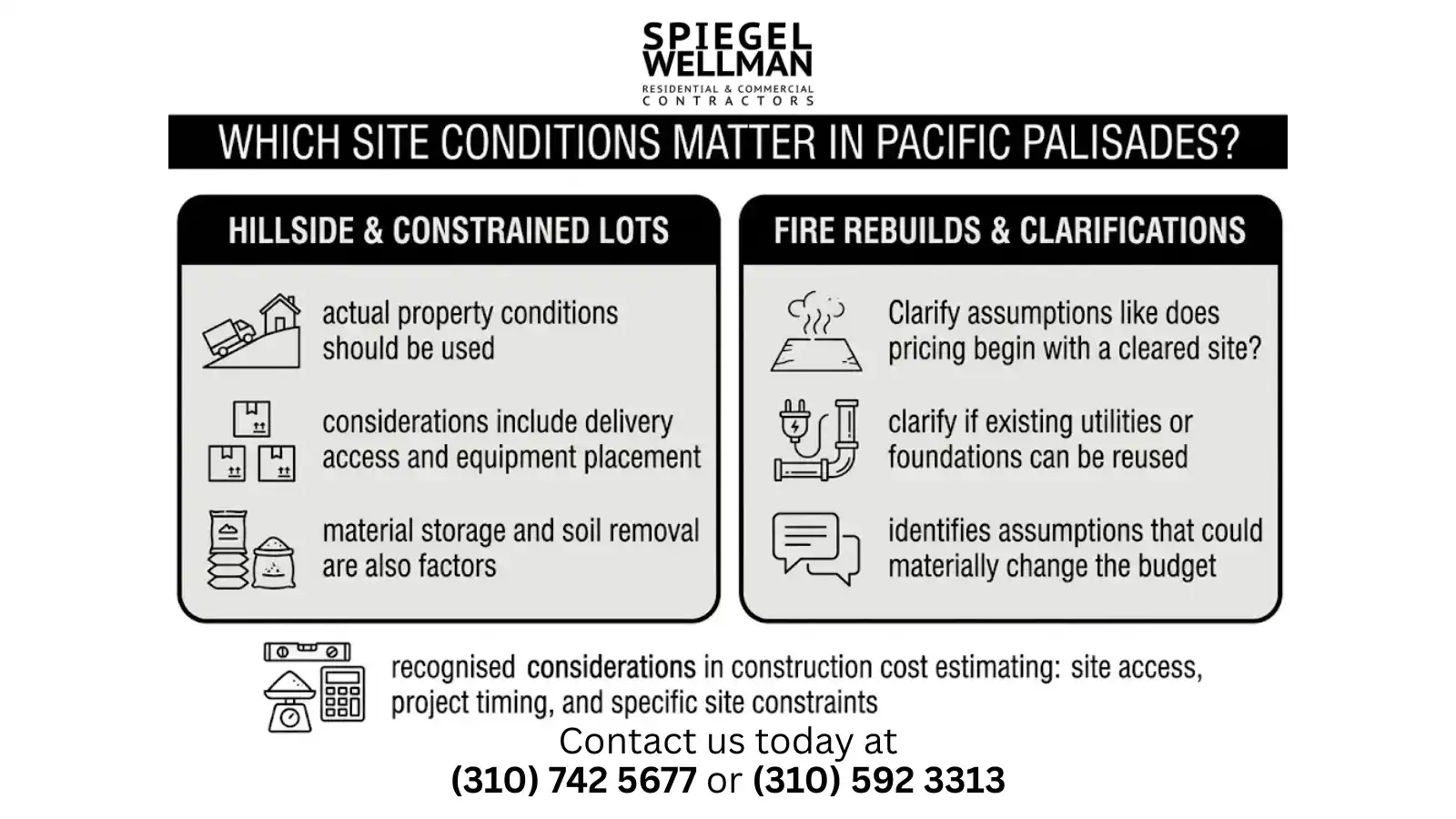
For a Pacific Palisades project, the estimator should use the actual property conditions rather than assume every site has the same construction needs.
On a hillside or constrained lot, questions may include delivery access, equipment placement, material storage, and soil removal. If access is limited, the proposed construction method and schedule may need closer review.
For a fire rebuild, clarify the starting condition assumed by the bid. Does pricing begin with a cleared site? Does it assume existing utilities or foundations can be reused? What investigations or design decisions are still outstanding?
Those questions do not mean every property requires the same work. They identify assumptions that could materially change the budget.
Site access, project timing, and specific site constraints are recognized considerations in construction cost estimating.
Call (310) 742-5677 to discuss your project
How Can a Lower Bid Become More Expensive?
A lower bid may remain the best value after review. The concern is whether it includes the same work as the alternatives.
Consider this hypothetical example, which illustrates comparison methods rather than local construction pricing:
| Comparison item | Bid A | Bid B |
| Original proposal | $240,000 | $255,000 |
| Required work confirmed as excluded | $22,000 | Included |
| Adjustment to match the same finish allowance | $8,000 | Already matched |
| Adjusted comparison total | $270,000 | $255,000 |
Bid A initially looks $15,000 lower. After accounting for the stated differences, its comparison total is $15,000 higher.
An adjusted comparison is a planning tool. It does not change the contractor’s offer. Confirmed additions and revised allowances should appear in an updated proposal before the homeowner relies on the new total.
Avoid assigning a guessed price to an unclear item and treating it as settled. Request clarification and pricing from the responsible contractor.
What Should You Receive After a Scope Review?
A useful review should leave you with an actionable record, not simply a statement that one bid “looks better.”
Ask for a comparison that identifies each unresolved item, the relevant drawing or specification, the contractor’s response, and any price or schedule effect.
For example, “clarify painting” is too broad. A more useful question is:
Does the painting scope include preparation and repainting of the existing wall surfaces disturbed by the new window installation?
Once answered, the clarification should be incorporated into the appropriate proposal or contract documents.
It is also helpful to keep three amounts visible: the contractor’s proposed price, owner-paid costs outside that proposal, and the remaining contingency. Combining them without explanation can hide responsibilities.
Can a Scope Review Prevent Every Change Order?
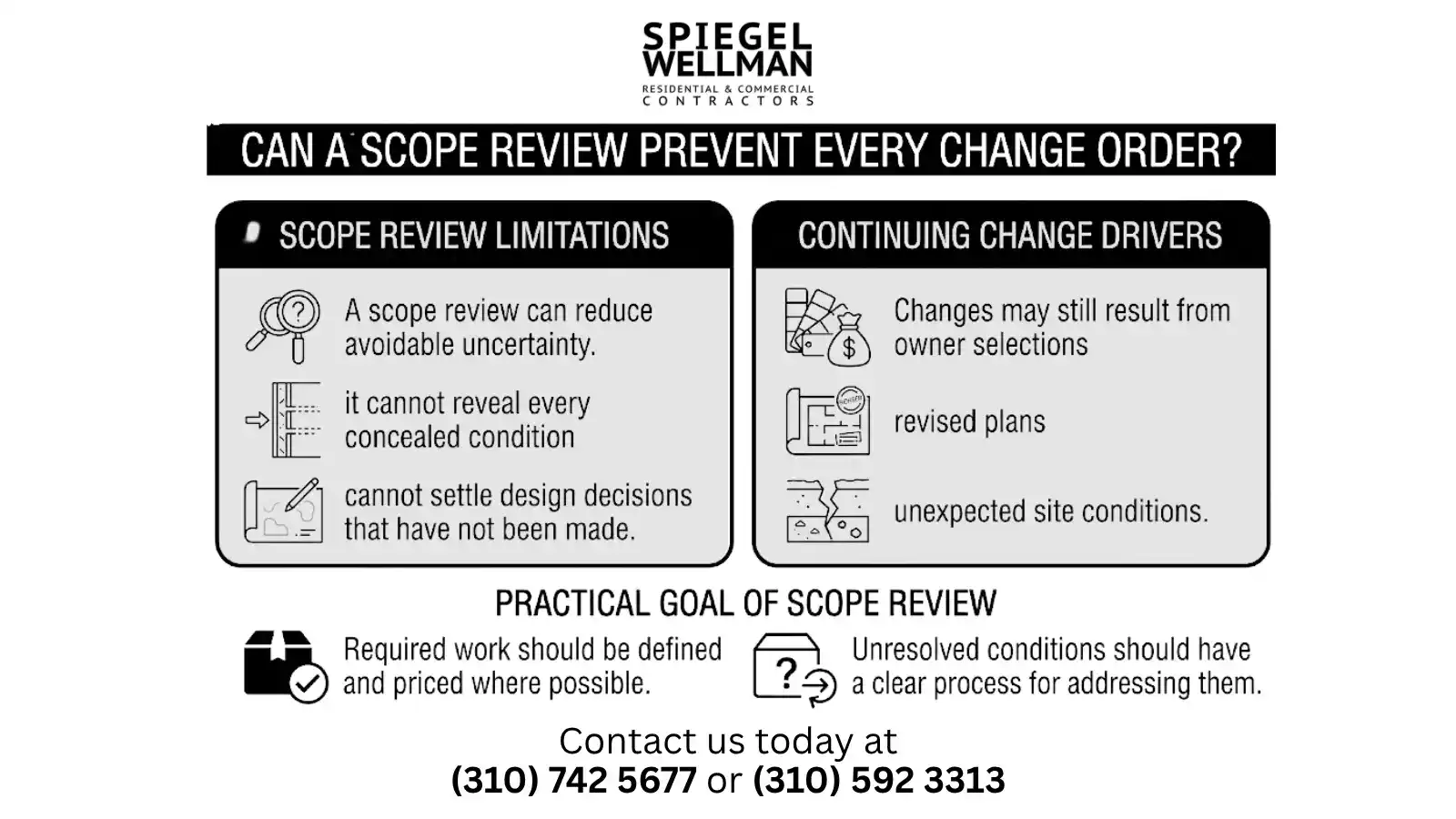
No. A scope review can reduce avoidable uncertainty, but it cannot reveal every concealed condition or settle design decisions that have not been made.
Changes may still result from owner selections, revised plans, unexpected site conditions, or other developments during construction.
The practical goal is to distinguish known work from genuine uncertainty. Required work should be defined and priced where possible. Unresolved conditions should have documented assumptions and a clear process for addressing them.
Call (310) 742-5677 to discuss your project
Discuss Your Pacific Palisades Project With Our Team
At Spiegel Wellman Contractors, we provide estimating support that reflects the information available at each stage, from preliminary budget planning to detailed scope review. Our work includes reviewing plans, specifications, selections, and site conditions to help identify potential gaps.
If you are preparing a rebuild, remodel, or custom home in Pacific Palisades, bring your plans and project questions to the conversation. contact us at (310) 742-5677 to discuss your project and our estimating services.
Frequently Asked Questions
Q: When should I hire a construction cost estimator?
A: Bring an estimator into the discussion during planning, then update the estimate as the design develops. Before choosing a contractor, a bid review can help determine whether competing proposals cover comparable work.
Q: Can an estimator review a bid without complete plans?
A: Yes, but the conclusions will be limited by the available information. An estimator can identify unclear assumptions and likely scope questions. Detailed pricing may need to wait for drawings, site information, or selections.
Q: Is an allowance a sign that something is missing?
A: Not necessarily. An allowance can be appropriate when a selection is pending. Check exactly what it covers, whether its amount fits the intended selection, and how any difference will be handled.
Q: Should I reject a contractor bid that contains exclusions?
A: Not automatically. Clear exclusions can help explain responsibility. The important question is whether necessary excluded work is assigned elsewhere and included in your overall project budget.
Q: Does a fixed-price bid mean every part of the project is covered?
A: The price must be read alongside the defined scope, exclusions, allowances, and assumptions. Ask the contractor to resolve unclear items in writing before you rely on the proposal.
Services We Also Serve