

A construction consultant helps property owners make better decisions about cost, scope, contracts, plans, contractors, scheduling, and problems that arise during a building project.
The consultant is there to look at the project from an experienced construction perspective and identify issues that may not be obvious to the owner.
At Spiegel Wellman Contractors, we may review an estimate before a homeowner signs a contract, compare contractor proposals, examine plans for scope gaps, evaluate budget concerns, discuss value-engineering opportunities, or provide ongoing support as construction progresses.
For Beverly Hills homeowners planning a custom home, major remodel, addition, or complicated renovation, that guidance can be particularly useful because one unclear decision can affect several trades, the budget, and the construction schedule.
Key Takeaways
- A construction consultant helps owners evaluate costs, plans, proposals, contracts, schedules, workmanship, and project risks.
- Consulting can begin before a contractor is hired or continue throughout construction.
- A consultant does not automatically replace the architect, engineer, contractor, or attorney; the role depends on the issue being reviewed.
- Proposal review can uncover differences in allowances, exclusions, scope, and assumptions that are hidden by the total bid price.
- Consultants can help identify value-engineering opportunities without treating the lowest-cost option as automatically better.
- Early consulting usually gives owners more options because problems are easier to address before contracts are signed or work is installed.
What Is a Construction Consultant?
A construction consultant is an experienced professional who advises an owner or project team on construction-related decisions.
The exact role varies by project.
Some clients need one meeting to review an estimate or contractor proposal. Others need a consultant involved through preconstruction or during the build.
At Spiegel Wellman Contractors, our consulting work can include proposal review, pre-contract review, budget and estimate review, plans and scope analysis, site observations, and practical problem-solving during construction.
The purpose is not simply to give another opinion.
Good consulting should help the owner understand what the available information actually means and what deserves closer attention before making a decision.
What Does a Construction Consultant Review?
A construction consultant can review many parts of a project, depending on where the project stands and what concerns the owner has.
Contractor Proposals
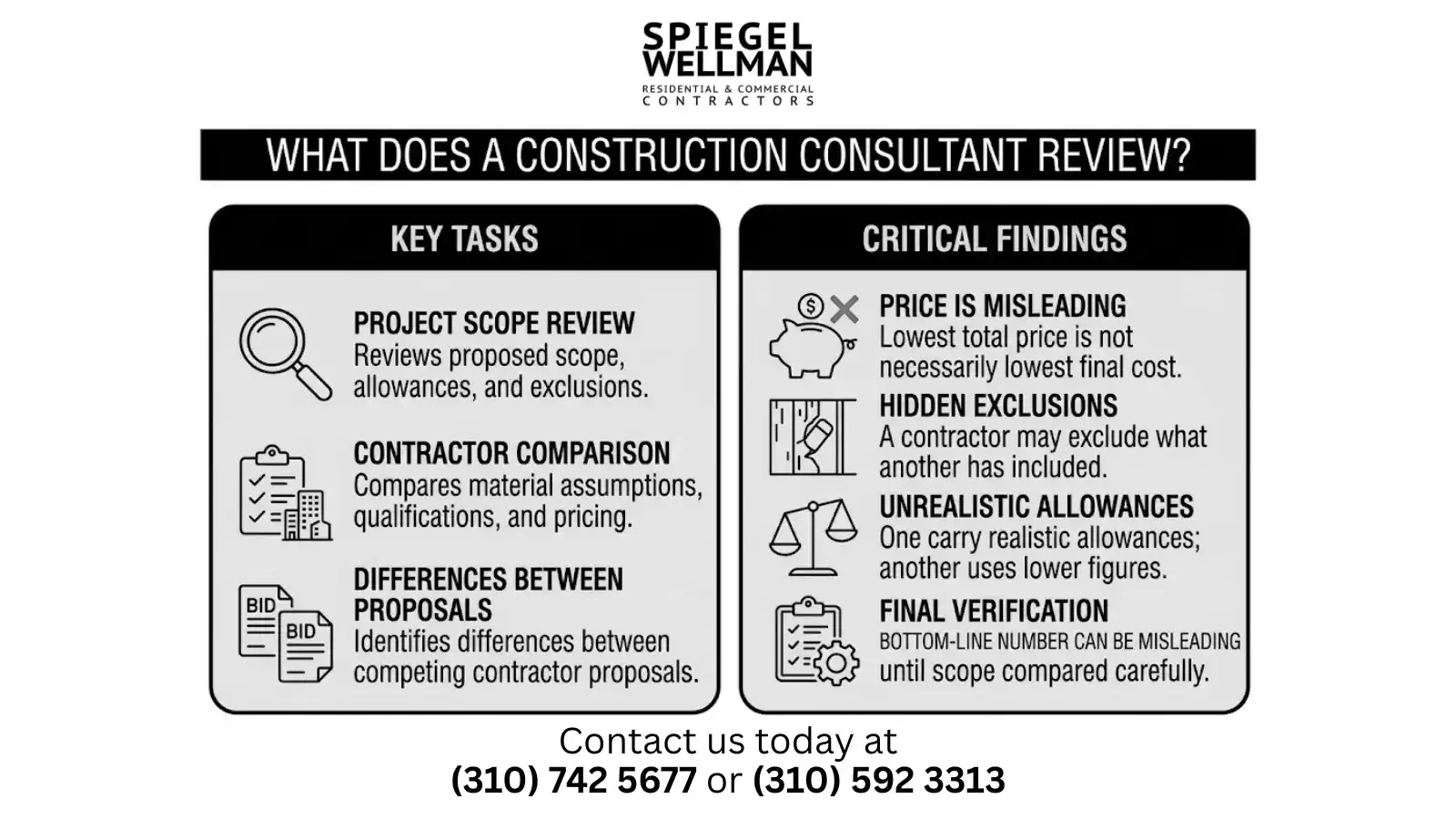
One of the most useful tasks is comparing contractor proposals.
Two bids can look similar—or very different—without actually covering the same work.
A consultant may review:
- proposed scope;
- allowances;
- exclusions;
- qualifications;
- pricing structure;
- material assumptions;
- responsibilities assigned to the owner;
- differences between competing proposals.
This matters because the lowest total price is not necessarily the lowest final cost.
A contractor may exclude something another contractor has included. One proposal may carry realistic allowances while another uses lower figures that could increase later.
Until the scope is compared carefully, the bottom-line number can be misleading.
Call (310) 742-5677 to discuss your project
A Construction Consultant Can Review the Budget and Estimate
A construction consultant can help determine whether an estimate appears complete, where the largest costs are coming from, and which assumptions deserve further review.
At Spiegel Wellman Contractors, our estimating process looks beyond material quantities. We consider plans, specifications, selections, site conditions, trade pricing, project sequence, scope, and potential value-engineering opportunities.
A consultant reviewing a budget may ask:
- Are important trades missing?
- Are allowances realistic?
- Has the project included appropriate contingencies?
- Does the estimate match the current plans?
- Are expensive areas of the scope clearly defined?
- Are there opportunities to reduce unnecessary costs?
- Could a proposed savings create another cost later?
These questions become more important as a project grows in complexity.
A Consultant Can Review Plans and Scope
Plans describe what is supposed to be built, but they do not always answer every construction question.
Different drawing sets may need coordination. A detail may be unclear. A specification may conflict with another document. An item the homeowner assumed was included may not appear in the contractor’s scope.
A construction consultant can review the available plans and project documents for gaps or areas that require clarification.
That does not mean the consultant replaces the architect or engineer.
If a concern requires architectural redesign, structural calculations, or another licensed professional’s expertise, it should be directed to the appropriate party.
The consultant’s value is often recognizing the construction consequence of an unresolved issue before it reaches the field.
Construction Consultants Help Owners Understand Contracts and Proposals
A construction contract controls important aspects of the relationship between owner and contractor, so unclear construction terms deserve careful review before signing.
A consultant may help identify practical construction concerns such as:
- unclear scope;
- missing work;
- vague allowances;
- unusual exclusions;
- responsibilities that have not been assigned clearly;
- payment structures that deserve clarification;
- inconsistencies between the contract and proposal.
At Spiegel Wellman Contractors, pre-contract consulting focuses on identifying construction-related scope, cost, and responsibility issues that owners should understand before moving forward.
A construction consultant should not be confused with a lawyer, however.
Questions involving legal rights, contract enforceability, liability, or legal interpretation may require review by a qualified attorney.
Consultants Can Help With Value Engineering
Value engineering is another common part of construction consulting.
It means reviewing the project to determine whether the budget can be used more efficiently without automatically compromising quality or design intent.
For example, an expensive construction detail might require extensive labor and custom fabrication.
A consultant might evaluate whether a simpler detail could achieve a similar visual result.
Another situation may involve two materials with different purchase prices. The lower-priced product may initially look like the obvious choice, but it could require more preparation or installation labor.
A useful value-engineering recommendation considers the complete effect.
That includes:
- material cost;
- labor;
- related trades;
- constructability;
- performance;
- durability;
- design priorities;
- possible schedule effects.
The goal is better value, not simply a smaller number.
A Construction Consultant Can Help Before You Hire a Contractor
You do not need to wait until construction starts to involve a consultant.
In many cases, consulting is most useful before a contractor agreement is finalized.
At this stage, the consultant can review proposals, estimates, project organization, plans, schedule assumptions, and unresolved scope questions.
Early review matters because owners still have choices.
A vague exclusion can be clarified.
An allowance can be adjusted.
A scope gap can be priced.
Two contractor proposals can be compared accurately.
A major budget issue can be discussed before the project is committed to a specific contract structure.
Once construction starts, many of those decisions become harder to change.
A Consultant Can Also Help During Construction
Construction consulting does not stop when work begins.
During construction, an owner may need help understanding progress, visible workmanship concerns, sequencing, unresolved scope issues, cost questions, or communication problems.
A consultant can provide another experienced set of eyes.
For example, an owner may be unsure whether a condition is normal work-in-progress or something that deserves immediate discussion with the contractor.
The consultant can help frame the right questions and identify what information should be requested.
At Spiegel Wellman Contractors, ongoing owner support can include project reviews, site observations, and decision support during design and construction.
Does a Construction Consultant Manage the Contractor?
Not always.
This depends on the scope of the consulting agreement.
Some consultants provide occasional advice. Others serve in a more active owner’s-representative role, helping coordinate information and monitor parts of the project.
A one-time consultation is very different from ongoing construction management.
Owners should define the consultant’s responsibilities clearly at the beginning.
Questions worth asking include:
- Will the consultant visit the site?
- How frequently?
- Will they review invoices or change orders?
- Will they communicate directly with the contractor?
- Are they advising only, or coordinating parts of the project?
- Are written reports included?
- Who remains responsible for final decisions?
Clear boundaries reduce confusion once construction begins.
What Is the Difference Between a Construction Consultant and a General Contractor?
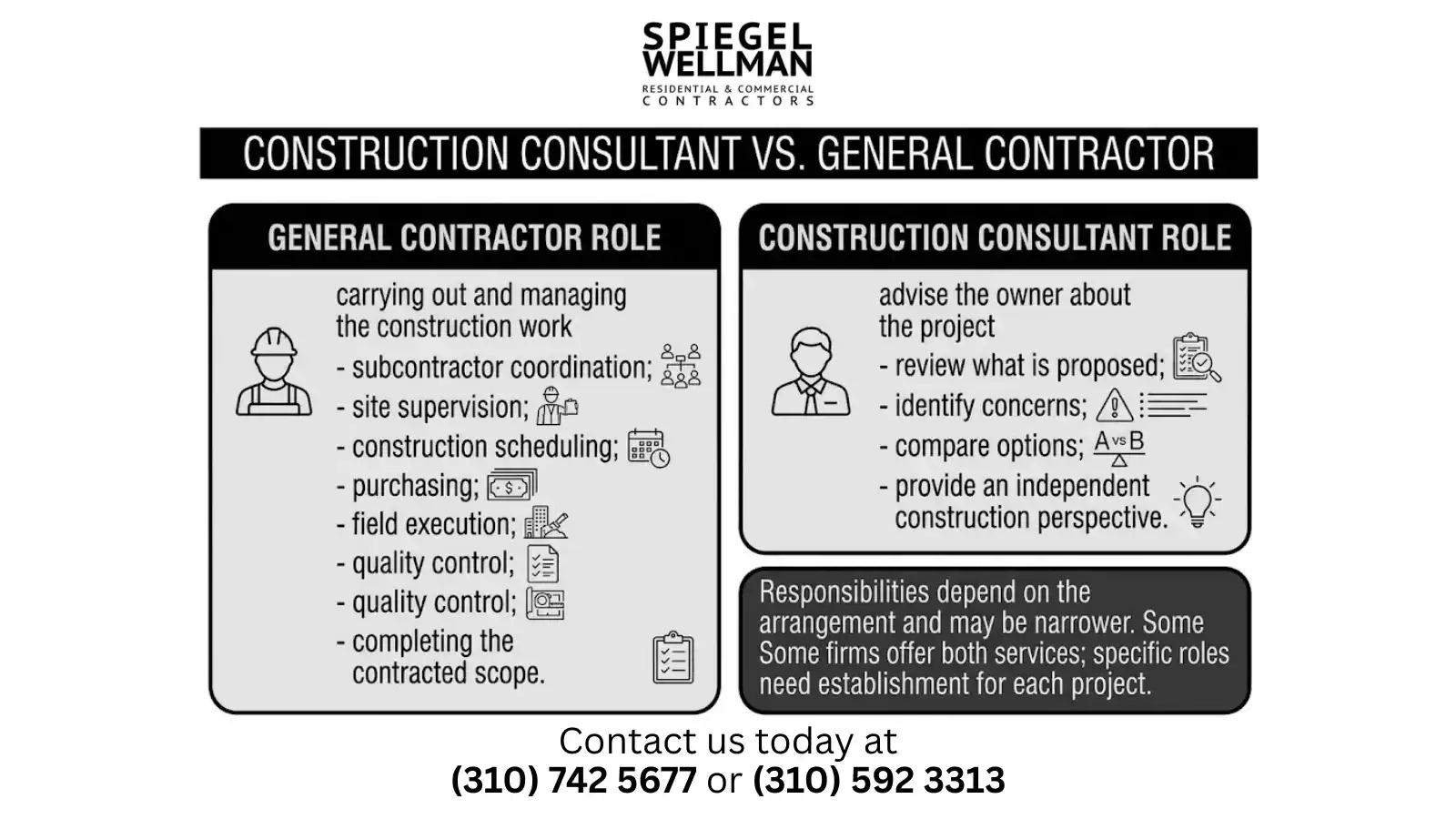
A general contractor is usually responsible for carrying out and managing the construction work under the construction agreement.
A consultant may instead advise the owner about the project.
The consultant can review what is proposed, identify concerns, compare options, or provide an independent construction perspective.
The general contractor may be responsible for activities such as:
- subcontractor coordination;
- site supervision;
- construction scheduling;
- purchasing;
- field execution;
- quality control;
- completing the contracted scope.
The construction consultant’s responsibilities depend on the consulting arrangement and may be much narrower.
In some firms, including Spiegel Wellman Contractors, construction and consulting services are both available. The specific role therefore needs to be established for each project.
Call (310) 742-5677 to discuss your project
What Is the Difference Between a Construction Consultant and an Architect?
Architects and construction consultants bring different perspectives.
The architect typically focuses on design, planning, documentation, coordination, and other architectural responsibilities associated with the project.
A construction consultant generally approaches the project from the standpoint of cost, scope, buildability, contractor proposals, sequencing, and field execution.
These perspectives can complement one another.
For example, an architect may develop a design detail that achieves an important visual goal.
A construction consultant may then identify that the detail requires substantial custom fabrication and suggest discussing an alternative that preserves the design intent while making construction more practical.
The decision can then be evaluated with the architect and other appropriate project professionals.
What Is the Difference Between a Construction Consultant and an Engineer?
An engineer is responsible for engineering analysis and technical design within the engineer’s professional discipline.
A construction consultant does not replace that technical responsibility.
Instead, the consultant may identify a construction concern that requires engineering input.
For example, a homeowner considering a major opening in a wall may want to know what the change could mean for the budget and construction scope.
A consultant can discuss those practical implications.
The actual structural design and calculations should come from the appropriate engineer.
When Should You Hire a Construction Consultant?
A consultant may be useful whenever you face a significant construction decision and do not have enough information to judge it confidently.
Several situations stand out.
Before Signing With a Contractor
This is a good time to review scope, pricing, allowances, exclusions, and proposal differences.
When Contractor Bids Are Difficult to Compare
If bids differ substantially, the difference may involve more than price.
A consultant can help determine whether each contractor is actually pricing the same work.
When Your Estimate Is Higher Than Expected
A budget review can identify major cost drivers and possible value-engineering opportunities.
When the Plans and Scope Do Not Seem Aligned
Unclear responsibilities and missing details should be resolved before they become field problems.
When Change Orders Are Becoming Difficult to Evaluate
A consultant can help examine the basis for proposed changes and identify what questions should be answered.
When Construction Has Developed Problems
Delays, unresolved workmanship concerns, communication breakdowns, or disagreements about scope may benefit from an experienced construction perspective.
The earlier an issue is identified, the more options the project team may have for addressing it.
What Can a Construction Consultant Help Prevent?
A consultant cannot guarantee that a project will have no problems.
Construction contains too many variables for that promise to be realistic.
However, careful review can help reduce avoidable problems caused by unclear information or rushed decisions.
Common examples include:
- comparing bids that contain different scopes;
- signing before major exclusions are understood;
- relying on unrealistic allowances;
- overlooking missing work;
- making late design changes;
- choosing materials based only on purchase price;
- allowing unresolved questions to reach the construction phase;
- failing to understand the cost implications of a project decision.
The value of consulting often comes from asking the right questions before those issues become more expensive.
Why Construction Consulting Can Matter on Beverly Hills Projects
Beverly Hills projects often involve custom residences, substantial renovations, property upgrades, additions, premium materials, and detailed architectural work.
Spiegel Wellman Contractors provides residential and commercial construction services in Beverly Hills, including custom homes, renovations, design, engineering coordination, permitting, estimating, and project management.
Projects with that level of detail can involve many interconnected decisions.
A change in one area may affect structural work.
A material selection may change installation requirements.
A scope revision may affect several trades.
A design decision may increase both construction cost and schedule requirements.
Construction consulting helps the owner understand those relationships before making a decision based on one factor alone.
How Much Involvement Does a Construction Consultant Need?
Not every project needs continuous consulting.
The right level depends on the problem.
One-Time Consultation
A focused meeting may be enough if you have one specific concern, such as a contractor proposal, estimate, or major project decision.
Preconstruction Review
A more detailed review can examine the plans, scope, proposals, budget, schedule, and overall project organization before work begins.
Ongoing Owner Support
Larger or more complicated projects may benefit from continued consultation throughout design and construction.
Spiegel Wellman Contractors currently offers all three types of consulting support depending on the client’s needs.
The key is matching the level of involvement to the project’s complexity rather than paying for more consulting than the situation requires.
What Should You Bring to a Construction Consultation?
The better the information available, the more useful the review can be.
Depending on the issue, useful documents may include:
- architectural plans;
- engineering plans;
- contractor proposals;
- estimates;
- specifications;
- material selections;
- project schedules;
- change-order requests;
- photographs;
- relevant project correspondence.
You may not have all of these.
That is fine.
The consultant can identify which documents are most important based on the question you are trying to answer.
Questions to Ask a Construction Consultant
Before hiring a consultant, ask how their experience relates to your project and what their review will include.
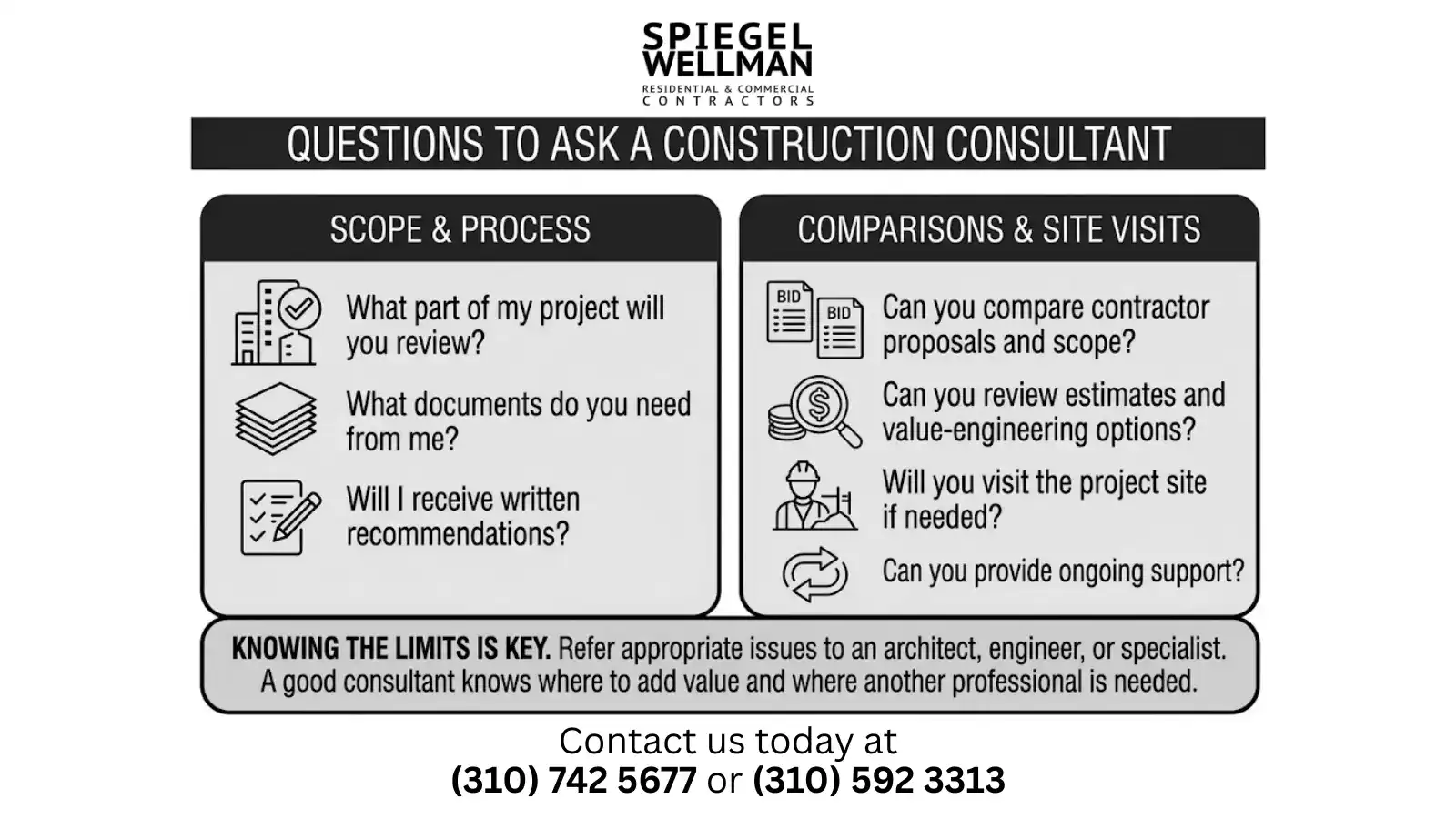
Useful questions include:
- What part of my project will you review?
- What documents do you need from me?
- Will I receive written recommendations?
- Can you compare contractor proposals and scope?
- Can you review estimates and value-engineering options?
- Will you visit the project site if needed?
- Can you provide ongoing support after the initial consultation?
- What issues would need to be referred to an architect, engineer, attorney, or another specialist?
That final question is important.
A good consultant should know both where their experience adds value and where another professional needs to become involved.
Call (310) 742-5677 to discuss your project
Get Clearer Information Before Making a Construction Decision
Construction projects involve hundreds of decisions, but some carry much greater consequences than others.
Choosing a contractor, approving a budget, signing an agreement, changing the scope, accepting a value-engineering option, or dealing with a developing field problem deserves more than guesswork.
At Spiegel Wellman Contractors, we bring decades of Southern California construction experience to consulting, estimating, design coordination, engineering, plans, permitting, and construction. Our consulting services can range from a focused project review to ongoing owner support.
If you are planning or already managing a construction project in Beverly Hills and want an experienced construction perspective before making your next decision, contact us at (310) 742-5677.
Frequently Asked Questions
Q: What does a construction consultant do?
A: A construction consultant advises owners on construction-related decisions involving plans, scope, budgets, contractor proposals, contracts, schedules, materials, workmanship, and project risks. The exact responsibilities depend on the project and the consulting agreement.
Q: When should I hire a construction consultant?
A: A construction consultant can be useful before contractor selection, during preconstruction, after construction starts, or when a project develops a problem. Early involvement generally provides more flexibility because scope, pricing, and contract questions can be addressed before work begins.
Q: Can a construction consultant review contractor bids?
A: Yes. A consultant can compare contractor proposals, including scope, allowances, exclusions, pricing structures, qualifications, and assumptions. This helps determine whether contractors are actually pricing comparable work instead of judging proposals by the total price alone.
Q: Can a construction consultant help reduce costs?
A: A consultant may identify unnecessary costs, unrealistic pricing, scope issues, or value-engineering opportunities. However, reducing the project price is not always the right recommendation. Cost decisions should also consider quality, design intent, constructability, durability, and the owner’s priorities.
Q: Is a construction consultant the same as a general contractor?
A: No. A general contractor is generally responsible for managing and carrying out the contracted construction work. A construction consultant primarily provides advice, review, and decision support. The consultant’s exact role depends on the scope of the engagement.
Q: Does a construction consultant replace an architect or engineer?
A: No. A construction consultant can identify practical construction concerns and recommend that an issue receive further review, but architectural design and professional engineering responsibilities should remain with the appropriately qualified professionals.
Q: Can a construction consultant help after construction has already started?
A: Yes. Consulting during construction may include project reviews, site observations, evaluation of unresolved concerns, scope questions, budget discussions, and decision support. The available solutions may be more limited once work is already installed.
Q: Does Spiegel Wellman Contractors provide construction consulting in Beverly Hills?
A: Yes. We provide construction consulting for Beverly Hills projects, including contractor proposal review, preconstruction review, budget and estimate evaluation, plans and scope review, project consultation, and ongoing owner support when appropriate.
Services We Also Serve